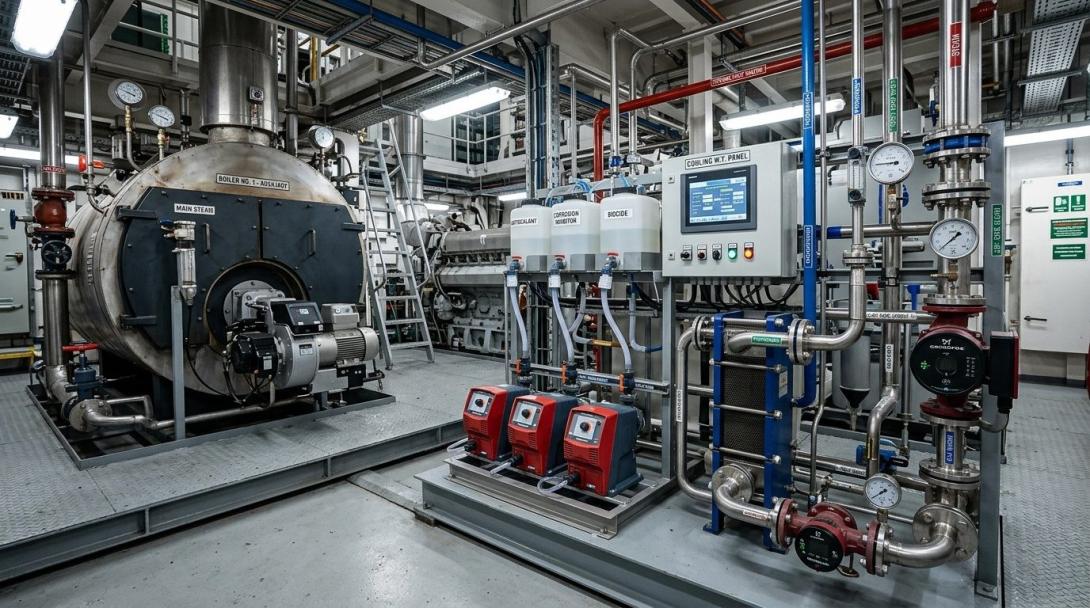
Cooling towers, chillers, boilers and process water systems in Umm Al Quwain run in hot, humid, salty conditions that are hard on equipment. Seawater-influenced air, high temperatures and hard water mean that untreated systems scale up, corrode and grow bacteria quickly. Water treatment chemicals prevent these problems, and most of them are simple once you understand what each one does.
The four problems
| Problem | What happens | Typical treatment |
|---|---|---|
| Scale | Calcium and magnesium salts coat heat exchangers and pipes, cutting efficiency | Scale inhibitors and descalers (acid-based or phosphonate-based) |
| Corrosion | Metal is eaten away, causing leaks and failures | Corrosion inhibitors, pH control |
| Biological growth | Algae, slime and bacteria foul the system and can include Legionella | Oxidising and non-oxidising biocides |
| Wrong pH | Too acidic corrodes metal, too alkaline encourages scale | Acid or alkali dosing, such as caustic soda |
Scale: the most common problem
Scale builds up when water evaporates and leaves its dissolved minerals behind, which is exactly what a cooling tower does all day. Even a thin layer reduces heat transfer and raises energy cost. Inhibitors keep minerals in solution, and when scale has already formed, a descaling chemical dissolves it. Always check that the descaler suits the metals in your equipment, and rinse thoroughly afterwards.
Corrosion: usually the costly one
Corrosion inhibitors form a thin protective film on metal. Their effect depends on correct dosing and water chemistry, so test the water regularly rather than adding chemicals by habit. Glycol-based circuits also need inhibitors, and aged, dark glycol is a sign they have been used up.
Biological control
Warm water is ideal for bacteria and algae. Sodium hypochlorite is a widely used oxidising biocide, and non-oxidising biocides are rotated in to prevent resistance. Cooling towers also need a documented cleaning and disinfection routine to manage Legionella risk. Follow the requirements that apply to your building or facility.
pH control
Most cooling and boiler systems run in a controlled pH window, which depends on the metals and treatment programme. Caustic soda raises pH, and acids lower it. Both are hazardous, so use dosing equipment where possible and keep eye wash facilities close by.
Testing: the part people skip
- Daily or weekly: pH, conductivity and biocide residual.
- Monthly: hardness, alkalinity, and inhibitor level.
- Yearly: a full water analysis from a laboratory and an inspection of heat exchanger surfaces.
A simple test kit and a written log catch most problems before they become shutdowns.
Choosing a programme
Start with the water: its source, hardness and chloride level. Then match the chemicals to the system type (open cooling tower, closed loop, boiler) and the metals involved. A small system may need nothing more than a scale inhibitor, a biocide and regular testing.
Water treatment supply for Umm Al Quwain
Fujairah Chemical supplies scale removers, biocides, pH adjusters and related chemicals for industrial and commercial water systems, and can arrange delivery to Umm Al Quwain. Send us the system type, water source and problem you are seeing, and we will recommend a programme and quote it. Call +971 9 224 2524 or email fujairahchemical@gmail.com. See also our guide to glycols for chillers and cooling circuits.
Frequently asked questions
How often should I descale?
It depends on water quality and operating conditions. Watch the approach temperature and pressure drop. If either climbs, scale is likely forming.
Can I use one chemical for everything?
Rarely. Scale, corrosion and biological growth are separate problems, though some blended products treat more than one.
Is hypochlorite safe for all metals?
No. Chlorine attacks some metals, so dose carefully and follow the equipment manufacturer's guidance.