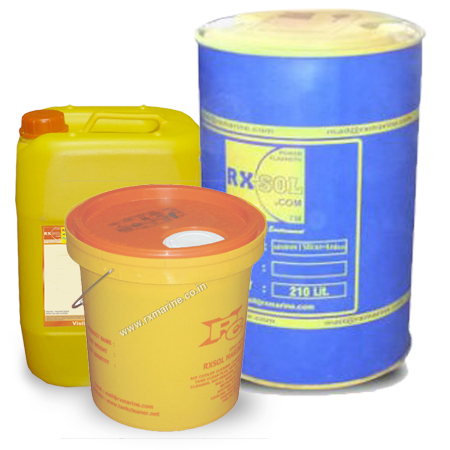
One Shot Universal Liquid Treat

It is a well – balanced blend for boiler water treatment products, resulting in a scale and corrosion control by one shot operation. A powdered one-step treatment to control the formation of rust and scale in low pressure and auxillary boilers with workin

SKU: RXSOL-40-5001-210 Category:

Description

It is a well – balanced blend for boiler water treatment products, resulting in a scale and corrosion control by one shot operation. A unique one-step Boiler treatment liquid  to control the formation of rust and scale in low pressure and auxillary boilers with working pressure up to 20 bars.







Product Details

Application

The dosage rate is dependent on the boiler operating condition, feed 2-3 ltrs of RXSOL-50-5001-020 solution per thousand ltr of boiler water then control the system by the periodic Alkalinity test procedure. If p-Alkalinity is below 200 ppm increase the ratio of RXSOL BWT 5001 solution. If p-Alkalinity is above 400 ppm reduce the concentration of RXSOL-50-5001-020 solution by dilution with water. RXSOL-50-5001-020 is strongly alkaline.RXSOL-50-5001-020  is best-applied heat or diluted with any convenient strength on a continuous basis using a suitable chemicals pump. The product should be applied to the boiler feed tank or feed line to ensure adequate mixing.

Dosage & Procedure

Control is by simple  boiler water tests or RX CLEANSERS  can provide a suitable test  kits for this purpose.

Used in low pressure and auxillary boilers

:::::::::::::::::::::Alkalinity  TEST FOR BOILER & COOLING WATER ::::::::::::::::::::::::

REAGENT & APPARATUS
:
Reagent:  RXSOL TK 7 , TK 8 , TK 9 , . Apparatus : TEST TUBE , Titrator or DROPPER

PROCEDURE for p-ALKALINITY  test ( STEP WISE ):

  1. Measure 10 ml of SAMPLE WATER in graduated TEST TUBE / CYLINDER
  2. Add 1-2 drops of  RXSOL TK7 and mix with the stirring rod , If  sample turns red / PINK ( which indicates presence of p-Alkalinity ) then follows 3rd step otherwise if sample remains colourless ( Record p-Alkalinity = 0 ) .
  3. Add RXSOL TK9  drop by drop ( by counting ) , mixing with the stirring rod until colour just disappears. Each drop is equivalent to 25 ppm of p-Alkalinity , expressed as CaCO3

RESULT  : Each DROPS is equivalent to  25 PPM of Alkalinity .

NOTE :    p-Alkalinity VALUE  =  25 X ( Total Number of DROPS of TK9 , during 3rdstep  )


PROCEDURE for p-ALKALINITY  & TOTAL ALKALINITY ( STEP WISE ):

  1. Measure 10 ml of SAMPLE WATER in graduated TEST TUBE / CYLINDER
  2. Add 1-2 drops of  RXSOL TK7 and mix with the stirring rod , If  sample turns red / PINK ( which indicates presence of p-Alkalinity ) then follows 3rd step otherwise if sample remains colourless ( Record p-Alkalinity = 0 ) then proceed to STEP- 4.
  3. Add RXSOL TK9  drop by drop ( by counting ) , mixing with the stirring rod until colour just disappears. Each drop is equivalent to 15 ppm of p-Alkalinity , expressed as CaCO3
  4. Add 2-3 drops of RXSOL TK8 and mix with stirring rod , the sample will turn to BLUISH-GREEN .
  5. AddRXSOL TK9 carefully by counting drop by drop and mixing throughly until a light reddish  pink  colour develop.

RESULT  : Each DROPS is equivalent to 25 PPM of Alkalinity .

NOTE :    p-Alkalinity ppm CaCO3VALUE ( A )  =  25 X ( Total Number of DROPS of TK9 , during 3rdstep  )

Total Alkalinity ppm CaCO3VALUE  =  A +  { 25 X ( Total Number of DROPS of TK9 , during 5th step  )}


NUMBER OF DROPS OF TK9                                                                                     p-Alkalinity as CaCO3                                

                        1 >>>>>>>>>>>>>>>>>>>>>>>>>>>>>>>>>>>>>>>>>>>>>>>>>>>>>>>25
                        2 >>>>>>>>>>>>>>>>>>>>>>>>>>>>>>>>>>>>>>>>>>>>>>>>>>>>>>>50

                        3 >>>>>>>>>>>>>>>>>>>>>>>>>>>>>>>>>>>>>>>>>>>>>>>>>>>>>>  75
                        4 >>>>>>>>>>>>>>>>>>>>>>>>>>>>>>>>>>>>>>>>>>>>>>>>>>>>>>  100

                        5 >>>>>>>>>>>>>>>>>>>>>>>>>>>>>>>>>>>>>>>>>>>>>>>>>>>>> > 125
                       10 >>>>>>>>>>>>>>>>>>>>>>>>>>>>>>>>>>>>>>>>>>>>>>>>>>>> >  250

                       20 >>>>>>>>>>>>>>>>>>>>>>>>>>>>>>>>>>>>>>>>>>>>>>>>>>>> >  500
                       30>>>>>>>>>>>>>>>>>>>>>>>>>>>>>>>>>>>>>>>>>>>>>>>>>>>>> >750

                       40 >>>>>>>>>>>>>>>>>>>>>>>>>>>>>>>>>>>>>>>>>>>>>>>>>>>>>  1000
 

Optimum Result    :   p-Alkalinity  level  is between 100 to  150 PPM is suggested.

 if  p-Alkalinity level is more then 150 ppm then level should be reduced by increased BLOW DOWN process with immediate effect.   

For Below  50 ppm  , Dose ½ Ltrs of RXSOL-50-5001-020for 1000 Ltrs of  BOILER WATER , to maintain p-Alkalinity level 100 ppm.

Refill pack : REPLACEMENTS  

TK7   : ECONOMIC PACK ( 100 / 200 / 500 ml ) available

TK8   : ECONOMIC PACK ( 100 / 200 / 500 ml ) available

TK9   : ECONOMIC PACK ( 100 / 200 / 500 ml ) available


For Tank cleaning operation pl. click here to know more................ 

OTHER VALUABLE PRODUCTS 

Alkalinity Control Alkalinity Test Kit Boiler Chemicals
Boiler Coagulant Boiler Water Sludge Conditoner Boiler Water Treatment Auto
CAT Sulphite COMBITREAT Combitreat Pwd
Condensate Control Condensol Amine Hardness Control
Multiplus BWt ONE SHOT UNIVERSAL Oxygen Control CorroisionI  nhibitor
Oxygen Scavanger I Oxygen Scavanger Plus  

Generic / Chemical Name

Boiler treatment liquid to control formation of rust and scale

Areas of Use

Basic Boiler System Schematic

Below is a summary of problems associated with the common impurities in water and solutions to each problem.

List Of Problems Caused By Impurities In Water


Impurity (Chemical Formula)

Problems

Common Chemical Treatment Methods

Alkalinity (HCO3-, CO32- and CaCO3)

Carryover of feedwater into steam, produce CO2 in steam leading to formation of carbonic acid (acid attack)

Neutralizing amines, filming amines, combination of both, and lime-soda.

Hardness (calcium and magnesium salts, CaCO3)

Primary source of scale in heat exchange equipment

Lime softening, phosphate, chelates and polymers

Iron (Fe3+ and Fe2+)

Causes boiler and water line deposits

Phosphate, chelates and polymers

Oxygen (O2)

Corrosion of water lines, boiler, return lines, heat exchanger equipments, etc. (oxygen attack)

Oxygen scavengers, filming amines and deaeration

pH

Corrosion occurs when pH drops below 8.5

pH can be lowered by addition of acids and increased by addition of alkalies

Hydrogen Sulfide (H2S)

Corrosion

Chlorination

Silica (SiO2)

Scale in boilers and cooling water systems

Lime softening

Supply Locations

Boiler Water Treatment chemicals manufacturer and supplier in India UAE Oman Nairobi, Sudan Yemen. One Shot Universal Liquid Treat is most advanced Boiler Water treatment Chemicals supplier in Mumbai, Navi Mumbai MIDC, Kolkata, Chennai, Haldia, Ennore, Paradip, Kandla Mundra Gandhidham, Visakhapatnam, Gangavaram, Kakinda, And in GULF Fuajirah, Dubai, Sharjah, Ajman, Abudhabi, UAE, Ruwi Barka Ghala, Muscat Oman, Nairobi Kenya, Sudan, Yemen

Industry Applications

Chemical feed should be continuous. Chemical pumping rates can create problems especially for neat feed set ups. Using on/off feed systems such as a recycle timer can create problems. Chemical feed pumps should be sized or product strengths should be adjusted to allow continuous feed.

Steam and carbon dioxide leave continuously, so setting up a neutralizing amine pump to feed intermittently can lead to wide variations in condensate pH control. If sampling is done from a condensate receiver, the tank volume may buffer the variations and the changes may not be noticed, but corrosion could be occurring to areas of the piping that see the rapidly changing pH.


If polymeric dispersants, phosphonates, phosphate, or chelants are fed intermittently into the feedwater using a recycle timer, and the amines are not fed continuously, a cycle of iron slugs returning in the condensate can be followed by slugs of high dispersancy cleaning of the iron from the deaerator and dragging it into the boiler.

Load changes can affect chemical concentrations when the chemical feed is base fed. Example: Steam production of one million lbs./day; 4% blowdown; 20% active boiler polymer product fed at 5 pounds per day. The calculated daily average polymer concentration would be 24 ppm. Assume peak plant production load is 60,000 lbs./hr., but during the overnight hours the load is only 5,000 lbs./hr. If the dispersant is being fed continuously over the 24 hours, during the 8- hour low load period, the boiler polymer concentration would have increased to over 200 ppm. Upon high fire when production resumes, carryover is very possible because of over concentrating the polymeric dispersant.

Chemical feed needs to be paced to steam production, especially where significant load changes occur.

Carbon dioxide can concentrate in steam and condensate making neutralizing amine treatment impractical. Carbon dioxide levels can be relatively low in steam exiting a boiler at only a few ppm, but if there are areas where it becomes “trapped” and can accumulate, concentrations can reach extremely high levels into the hundreds or even thousands of ppm.

CO2 is a non-condensable gas. It has a distribution ratio in the steam piping and condenses at points throughout the system. At the boiling point, the solubility of the gas in water is extremely low. The solubility of the CO2 is actually lower in the condensate than it is in the steam. For the CO2 to escape from the steam into the water it will accumulate in the steam space just above the water level until the partial pressure becomes high enough for the CO2 in the incoming steam to be able to exit into the condensate. This creates a steady state condition of CO2 coming in and exiting, but an area of severe localized corrosion occurs where the carbon dioxide concentration is high.

The highest CO2 concentration normally occurs just above the condensate water level. If there is an area where condensation is occurring and running down pipes or the sides of vessels, the CO2 concentration will be very high and the pH will be about 5.3 – 5.5 in that location creating high corrosion rates.


The solubility of CO2 increases dramatically as the condensate temperature falls below 212 °F. When there is an accumulation of CO2 in an area and the condensate temperature is relatively low, the amount of carbon dioxide going into solution will be extremely high. Where low-pressure steam is used that contains CO2 and the heat exchange process has relatively close temperature differentials between the steam and the condensate, there is potential for high uptake of the CO2 into the condensate and localized low pH.

Neutralizing amines are selected in an effort to condense in the right concentrations to carbon dioxide condensation levels throughout the steam system. Neutralizing amines cannot control corrosion where this localized accumulation of carbon dioxide occurs since the high CO2 overwhelms the demand for the amine. Even point source addition of amine may not be able to satisfy the demand.

Where the concentrating effect of CO2 occurs, methods of reducing the problem include eliminating or minimizing CO2 in the steam, venting off the CO2 in the localized area, eliminating condensate in the area, applying a filming amine or metal passivator, or using higher temperature steam and increasing condensate temperature to reduce the CO2 content in the condensate.

Safety Data (MSDS)


Product Name : RXSOL-50-5001-210
Product Type :

BOILER WATER TREATMENT

 Company Details:

RX MARINE INTERNATIONAL
105, A wing , BSEL , TECH PARK.
VASHI ,NEW BOMBAY 400703 INDIA

Phone : +91 22 65113333 / 5555 / 9999 / 27611360
Fax : +91 22 2781 1318 :::AOH :0091 9821214367
Email : mail@rxmarine.com

 Chemica Name

 Concentration

 CAS Number

EC Number

 R Phrases*

 Symbols

 Potassium   hydroxide         

 1-5

 1310-58-3

215-181 

 22-35

 C

 Tripotassium phosphate

 1-5

 7778-58-3

231-907-1 

*See Section 16

corrosive

Corrosive

Odour

Odourless

Appearance

Liquid, colour less to yellow, soluble in water

Contact with eyes

Corrosive to eyes, Can cause damage to the eyes

Contact with skin

Causes burns(R34)

Inhalation

No information available but must be considered harmful

Ingestion

Harmful if swallowed(R22)

Contact with skin

Remove contaminated clothing immediately and drench affected skin with plenty of water. Then wash withsoap and water. Seek medical advice if necessary.

Contact with eyes

If substance has got into eyes, immediately wash out with plenty of water for at least 15minutes Irrigate eyes thorough lywhilst lifting eyelids   Obtain immediate medical attention.Continue flushing with water until medical help arrives.

Ingestion

Do not induce vomiting Never give anything by mouth to anunconscious person.Give water or milk to drink Obtain immediate medical attention.

Inhalation

Inhalation is unlikely to occur Seek medical attention if ill effects occur.

General

In case of accident or if you feel unwell, seek medical advice immediately (show the label where possible)(S45) When in doubt orsymptoms persist, seek medical attention.

-  Non combustible
-  Not flammable. In case of fire use extinguishing media appropriate to surrounding conditions

Personal Precautions

Wear protective clothing as persection 8.

Environmental Precautions

No special precautions are required for this product.

Clean Up Actions

Absorb spillageininert material and shovelup.Ventilate the area and wash spill site after material pick-up is complete.

Special Precautions

Wear protective clothing as persection 8.

Handling

Wear protective clothing as persection 8 Eye wash bottles should be available Avoid contact with skin and eyes(S24/25)

Storage

Keep only in the original container in a cool, well ventilated place(S3/9/49).Keep container tightly closed(S7)

Exposure Limits

TLV(TWA)2mg/m3(Potassium hydroxide)

Exposure controls

No special precautions are required for this product

Occupational exposure controls

Wear suitable protective clothing,including eye/face protection and gloves(plastic or rubbera recommended)

                                                           gloves               suit                 goggles                 no_smoking

                                                            Gloves                        Suit                      Goggles              No_Smoking

Odour

Odourless

Appearance

Liquid, colour less to yellow, soluble in water

pH

13at 100%concentration

pH9.5

11at 0.2 %concentration

Boiling point &gt

100°Cat 760mm/Hg

Vapourpressure

not known

Vapourdensity

not applicable

Freezing point

<0°Cat 760mm/Hg

Soluble in water

Completely

Specific gravity

(water=1)1.135

-  This article is considered stable under normal conditions
-  Avoid over heating, Keep away from frost
-  In compatible with acid
-  See Section 5

Toxicological information

No experimental data available

Inhalation

In halation is unlikely to occur

Contact with skin

Prolonged skin or eye contact may cause chemical burns

Contact with eyes

Prolonged skin or eye contact may cause chemical burns

Ingestion

The ingestion of significant quantities may cause burning sensation

Carcinogenicity

No evidence of carcinogenic effects

Ecotoxicity

May cause acute effects in the aquatic environment

Mobility

Completely soluble in water

Persistence and Biodegradability

Degrades by hydrolysis

Bioaccumulation Potential

Bioaccumulation of the components in this product is insignificant.

Other Adverse Effects

No environmental problems are expected when the product is used / handled correctly. In its intended use, the product will not be released into the environment. Presents little or no hazard to the aquatic environment

Classification

EUWasteclass: 06.02  This material and/or its container must be disposed of as hazardous

 Disposal considerations

Do not discharge into drains or the environment,dispose to an authorised waste collection point Disposal should be in accordance with local, state or national legislation

Proper Shipping Name
UN        
  Proper Shipping Name Potassium hydroxide, solution    
  UNNo 1814    
  Hazard Class 8 PackingGroup: III
Road/Rail(ADR/RID)
  Proper Shipping Name

Potassium hydroxide, solution

   
  ADR UN No 1814    
  ADR Hazard Class      

Sea(IMDG)

  Proper Shipping Name Potassium hydroxide, solution    
  IMDG UN No      
  IMDG Hazard Class 8 IMDG PackGroup.: III
  IMDG EmS F-A, S-B IMDG subrisk

N/A

  IMDG Labels 8 IMDG Flash point:

N/A

Air(ICAO/IATA)

  Proper Shipping Name Potassium hydroxide, solution    
  ICAO Un No

1814

   
  ICAO Hazard Class 8 ICAO Packing Group. III
  ICAO subrisk

N/A

ICAO Labels 8, CAO
  ICAO Flash point

N/A


DOT/ CFR (US Department of Transportation

  DOT Proper Shipping Name Potassium hydroxide, solution    
  Hazardous Material potassium hydroxide    
  Hazard Class 8 Identification Number UN1814
  Product RQ (lbs) 1000 DOT subrisk

N/A

  DOT Labels 8 DOT Flashpoint:

N/A

 RiskPhrases

Causesburns (R34)

 SafetyPhrases

In case of contact with eyes, rinse immediately with plenty of water and seek medical advice(S26).Wear suitable protective clothing, eye/face protection and gloves(S36/37/39).In case of accident or if you feel unwell, seek medical advice immediately(show the label where possible)(S45)

Text of Rand Sphrase codes used in this safety data sheet:-R22: Harmful if swallowed;R35: Causes severe burns.The information provided about the product on this Safety Data Sheet has been compiled from knowledge of the individual constituents The data given here is based on current knowledge and experience. This Safety Data Sheet describes the product interms of safety requirements and does not signify any warranty with regard to the product's properties .The data given here only applies when product used for proper application(s). The product is not sold assuitable for other applications-usage in such may cause risks not  mentioned in this sheet. Donot use for other application(s) without seeking advice from manufacturer

DISCLAIMER OF LIABILITY :The information in this SDS was obtained from sources which we believe are reliable. However, the information is provided without any warranty, express or implied, regarding its correctness. The conditions or methods of handling, storage, use or disposal of the product are beyond our control and may be beyond our knowledge. For this and other reasons, we do not assume responsibility and expressly disclaim liability for loss, damage or expense arising out of or in any way connected with the handling, storage, use or disposal of the product. This MSDS was prepared and is to be used only for this product. If the product is used as a component in another product, this MSDS information may not be applicable.

top